The data comes from on-site surveys. Where there is no survey, no judgment appears: we prefer to say we don't know rather than give you unverified information.
How to read the scale
The level refers to one type of disability at a time. A place can be fully accessible for wheelchair users and completely unsuitable for those who are blind: that's why there is no single rating, and each type has its own evaluation.
Not accessible
Has obstacles that prevent enjoyment.
Accessible with difficulties
Accessible, but with significant difficulties to overcome.
Partially accessible
Some parts are accessible, others are not.
Accessible with a companion
Accessible with the help of a companion.
Fully accessible
Accessible independently, without known barriers.
Mobility impairment
Accessible with difficulties
level 2 out of 5
Verified on 14/09/2026
Visual impairment
Fully accessible
level 5 out of 5
Verified on 14/09/2026
Hearing impairment
Fully accessible
level 5 out of 5
Verified on 14/09/2026
Cognitive disability
Partially accessible
level 3 out of 5
Verified on 14/09/2026
Older adults and reduced mobility
Fully accessible
level 5 out of 5
Verified on 14/09/2026
Services detected on site
Access rampNo
Lift or stairliftNo
Accessible toiletNo
Reserved parking spaceNo
Step-free entranceNo
Tactile guide path (LOGES)No
Tactile map or modelNo
Braille signageNo
Audio guide availableYes
Italian Sign Language (LIS) videoYes
Subtitled contentNo
Hearing loopNo
Easy-read signage / AACNo
Drinking water pointNo
Did you find a situation different from the one described?
The story translated into Italian Sign Language by an interpreter.
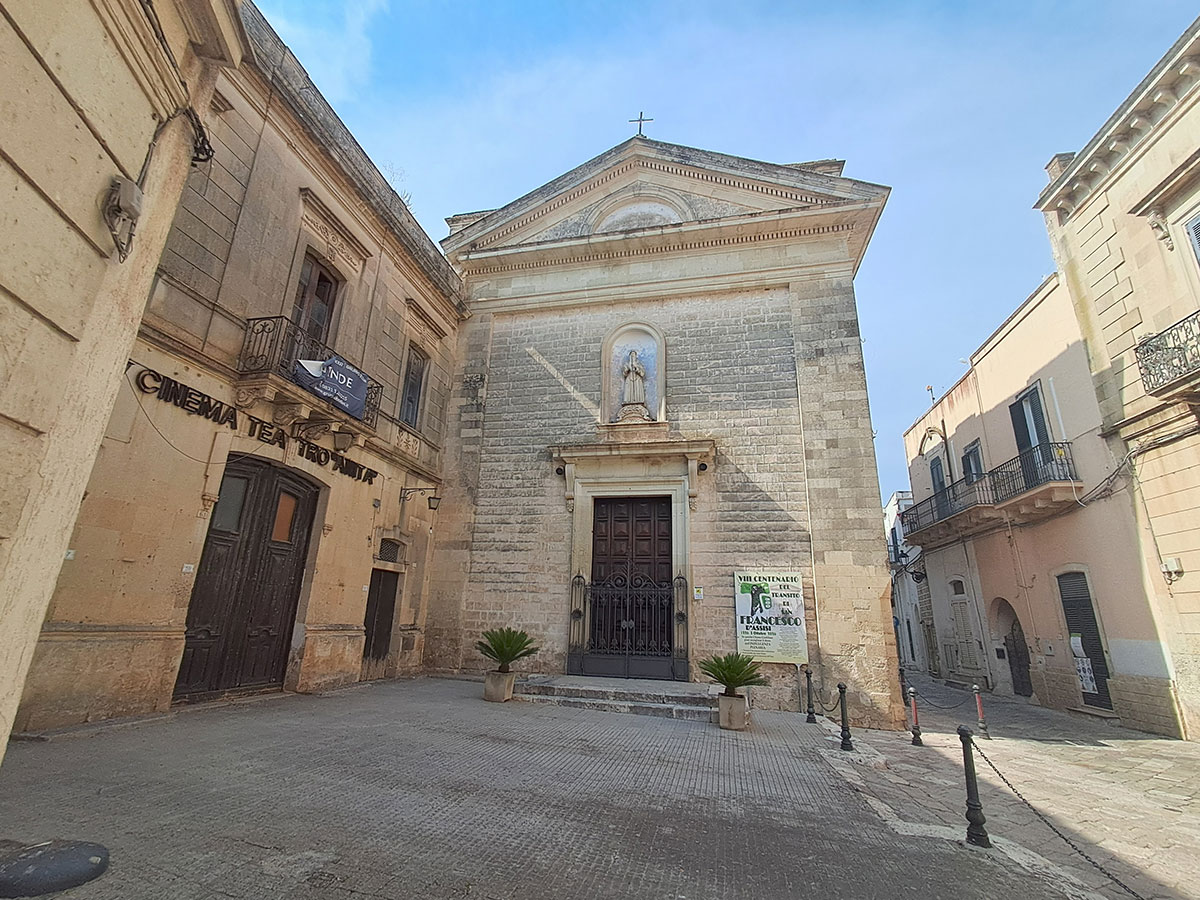
In the heart of Poggiardo, along Corso Vittorio Emanuele, stands the Church of San Francesco d'Assisi, a testament to the long Franciscan presence in the history of the community. San Francesco
The church was built at the end of the sixteenth century along with the adjacent convent. After a long period of abandonment, in the early years of the nineteenth century, part of the structure collapsed. It was restored and rebuilt in the second half of the nineteenth century, taking on its current neoclassical appearance.
The interior, simple and intimate, is characterized by a single rectangular nave, with six side altars, three on each side, in addition to the main altar. Numerous papier-mâché statues, expressions of one of the most characteristic artistic traditions of Salento, enrich the sacred space.
But there is a particular detail that makes this church even more connected to the history of the community: although it is dedicated to San Francesco d'Assisi, for centuries it has hosted popular devotion to Saints Cosmas and Damian, a testament to a religious tradition of Eastern origin that has remained deeply rooted in the territory.
For those traveling along the Via Francigena, it is a small but significant stop of faith and memory, where Franciscan spirituality meets the popular devotion of Salento.
Images
Images of Chiesa San Francesco d'Assisi
Arrows to scroll, plus and minus to zoom, Esc to close.