The story translated into Italian Sign Language by an interpreter.
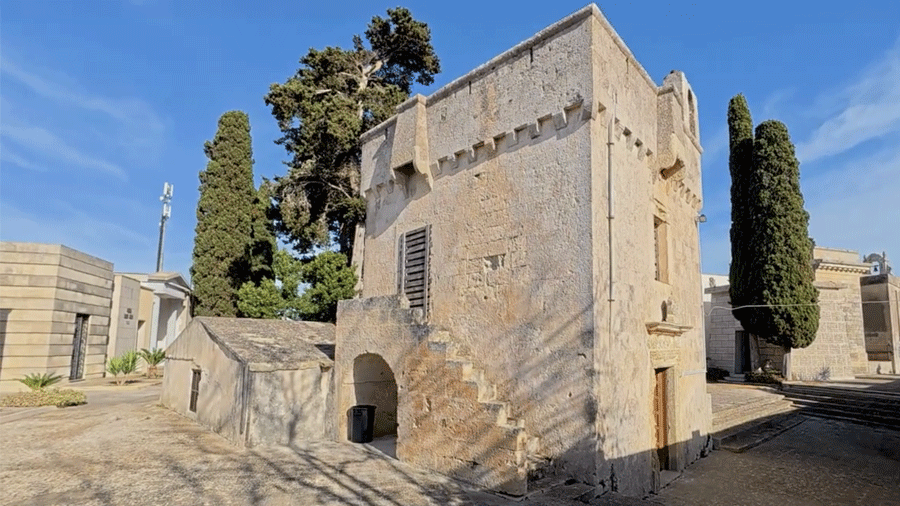
In the cemetery of Poggiardo stands a structure that immediately captures attention: a fortified tower equipped with loopholes corresponding to the openings, similar to the coastal towers of Salento built between the 15th and 16th centuries to defend the territory from the continuous attacks of Saracen pirates. Leaning against the tower is a singular building, with a sloping double-pitched roof, which further enhances the uniqueness of the ensemble.
The presence of a defensive structure in a cemetery is already unusual in itself, but what makes it unique is the small bell tower placed at the top of the tower. This detail reveals the true nature of the building: inside the tower, there is indeed a small church, belonging to the type known as Church-Towers. These architectures emerged around 1500, after the fall of Otranto, in a period marked by frequent Turkish attacks, when there was an effort to fortify everything: farms, houses, and even churches, often targets of raids.
The small church, dedicated to the Madonna della Grotta, is partly underground: the altar is indeed much lower than the ground level and is accessed via a staircase carved into the rock, which starts directly from the entrance door of the tower. Immediately after the stairs, on the left wall, there is a fresco depicting the Holy Doctors, while on the right wall, the image of a pilgrim saint is visible.
The presence of some tombstones on the walls testifies to a particular use of the structure: between 1841 and 1873, following the ban on burials in urban churches, the crypt was used as a burial place, until the construction of the current cemetery. In addition to the older frescoes, there are 18th-century paintings, including an Immaculate Madonna and a Saint Lucia.
The altar, rebuilt in the 18th century in elegant Baroque style with Lecce stone, represents the beating heart of the crypt. In the center is a fresco framed by a mandorla, depicting the serene and luminous face of the Madonna della Grotta, always an object of deep veneration by the local community. On either side of the altar, two small doors open, evidence of the presence of an ancient iconostasis.
Behind the altar, one accesses the innermost part of the cave, located beneath the structure with the sloping roof described earlier. This space, probably the oldest core of the complex, was used in the past as an ossuary: through a loophole, the bones of the deceased were dropped into this space, giving the place an aura of mystery and contemplation.
The semi-underground configuration of the small church and the presence of the cave behind suggest that the building arose on a pre-existing sacred site, probably of Byzantine origin and partly underground, confirming the long cult continuity of the area.
Images
Images of Chiesetta Fortificata della Madonna della Grotta
Arrows to scroll, plus and minus to zoom, Esc to close.