The data comes from on-site surveys. Where there is no survey, no judgment appears: we prefer to say we don't know rather than give you unverified information.
How to read the scale
The level refers to one type of disability at a time. A place can be fully accessible for wheelchair users and completely unsuitable for those who are blind: that's why there is no single rating, and each type has its own evaluation.
Not accessible
Has obstacles that prevent enjoyment.
Accessible with difficulties
Accessible, but with significant difficulties to overcome.
Partially accessible
Some parts are accessible, others are not.
Accessible with a companion
Accessible with the help of a companion.
Fully accessible
Accessible independently, without known barriers.
Mobility impairment
Fully accessible
level 5 out of 5
Verified on 15/09/2026
Visual impairment
Fully accessible
level 5 out of 5
Verified on 15/09/2026
Hearing impairment
Fully accessible
level 5 out of 5
Verified on 15/09/2026
Cognitive disability
Partially accessible
level 3 out of 5
Verified on 15/09/2026
Older adults and reduced mobility
Fully accessible
level 5 out of 5
Verified on 15/09/2026
Services detected on site
Access rampYes
Lift or stairliftNo
Accessible toiletYes
Reserved parking spaceYes
Step-free entranceNo
Tactile guide path (LOGES)No
Tactile map or modelNo
Braille signageNo
Audio guide availableYes
Italian Sign Language (LIS) videoYes
Subtitled contentNo
Hearing loopNo
Easy-read signage / AACNo
Drinking water pointYes
Did you find a situation different from the one described?
The story translated into Italian Sign Language by an interpreter.
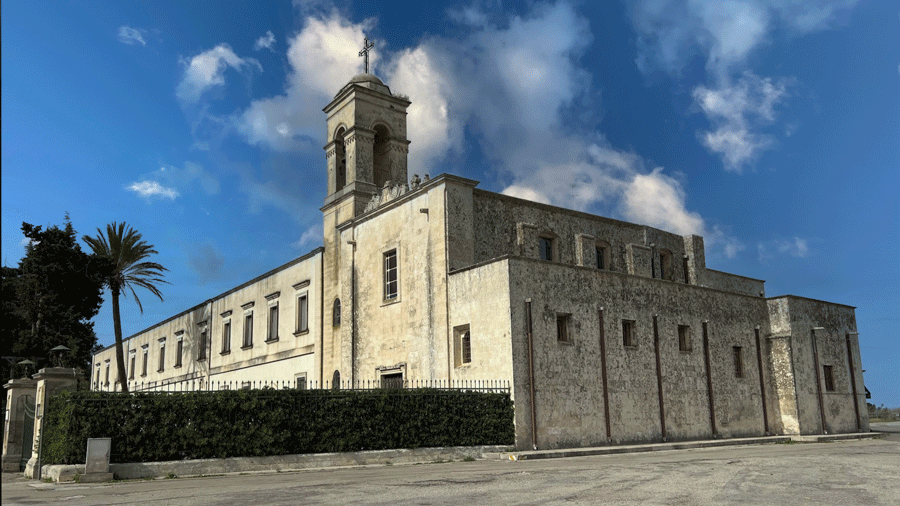
The Monastery of Santa Maria della Consolazione is located outside the center of Martano, on the road to Borgagne, in the Sinobbie area, an ancient settlement of Byzantine monks. The current building was constructed in 1686 at the request of the people of Martano, based on a design by Oronzo Trevisi from Campi, a student of Giuseppe Zimbalo, repurposing stones from two ruined hermitic churches, San Biagio and San Giorgio.
After being managed for two centuries by the Alcantarini fathers, and following a long period of abandonment and improper uses, the monastery was entrusted in 1926 to the Cistercian monks, who are still present today.
The facade, austere and essential, is animated only by scrolls and chalices overflowing with flowers and fruits; the interior, with three naves, houses six altars and the icon of the Madonna della Consolazione, dating back to the Fifteenth Century.
Today, the monastery is also known for the production of the bitter San Bernardo, according to an ancient eighteenth-century recipe from the Abbey of Casamari.
Images
Images of Convento dei Cistercensi
Arrows to scroll, plus and minus to zoom, Esc to close.