Churches and places of worship
Hypogea and crypts
Giurdignano
Listen, watch, mark
Sign language
The story translated into Italian Sign Language by an interpreter.
The Byzantine crypt of San Salvatore dates back to the 8th to 10th century, built and used as a place of Orthodox worship. The discovery of the crypt occurred in the 1980s, thanks to the deconsecration interventions of the small church above, San Vincenzo. The citizens had always been aware of this crypt without recognizing its immense value, and therefore it was used as a refuge during the world wars and as a cistern for water (which is why the frescoes are all damaged at the same level in the lower part).
Entirely excavated in negative in Lecce stone, its plan consists of three naves: four pillars define nine bays that end with three apses. For each of these, there is a small altar carved, like the columns, from a single block of stone. Between the apses and the rest of the environment, there is a small dividing perimeter that delineates two areas, the bema and the naos. The first indicates the area reserved for the priests, who usually used the central altar facing away from the faithful so as not to turn towards the Madonna, according to the Orthodox rite. The two side altars were used to place the sacred books for the celebrations (to the right) and to store the vestments and ceremonial garments (to the left).
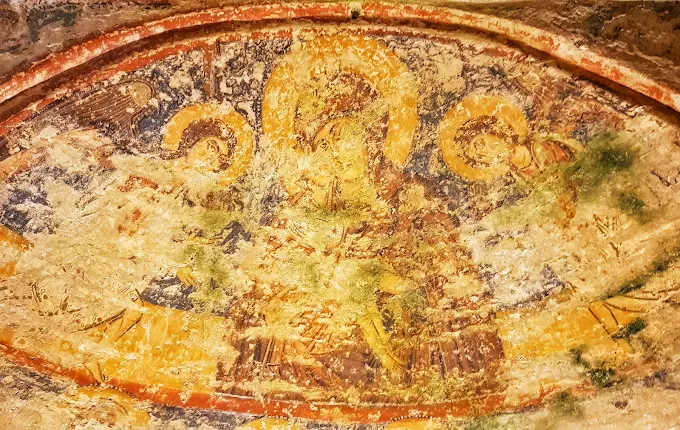
A significant feature of this crypt is the frescoes and the ceilings. Of all the frescoes, only a few have survived: among these, the main one in the center where the Madonna with the Child Jesus and two Archangels can be found; below, the halos of some of the 12 apostles can still be glimpsed. The arches were also frescoed, but the only one remaining visible to us is the one where Saints Cosmas and Damian (the Holy Physicians) are located.
The others, in addition to the wear of time, may have been damaged by strong humidity, possibly caused by a total or partial immersion of the paintings in water. The Greek-Byzantine celebration survived in Italy until the suppression of the religious order (although now reduced to a simple rite) which occurred between the 18th and 19th centuries and concluded definitively in the two decades following the annexation of the Kingdom of the Two Sicilies to Italy.
The ceilings of the crypt are differently sculpted in order to create various types: coffered, with a Greek cross, a motif with four sail vaults, and, in the central nave, just before the area that delineates the bema, the symbolism of a ladder, which indicates the ladder leading to Paradise, represented by three concentric circles, as in Dante's Divine Comedy, and which coincides with the bema.
Images
Images of Cripta di San Salvatore
Arrows to scroll, plus and minus to zoom, Esc to close.