Archaeological sites
Traditions and crafts
Martano
Accessibility of this place
The data comes from on-site surveys. Where there is no survey, no judgment appears: we prefer to say we don't know rather than give you unverified information.
How to read the scale
The level refers to one type of disability at a time. A place can be fully accessible for wheelchair users and completely unsuitable for those who are blind: that's why there is no single rating, and each type has its own evaluation.
Not accessible
Has obstacles that prevent enjoyment.
Accessible with difficulties
Accessible, but with significant difficulties to overcome.
Partially accessible
Some parts are accessible, others are not.
Accessible with a companion
Accessible with the help of a companion.
Fully accessible
Accessible independently, without known barriers.
Mobility impairment
Accessible with difficulties
level 2 out of 5
Visual impairment
Fully accessible
level 5 out of 5
Hearing impairment
Fully accessible
level 5 out of 5
Cognitive disability
Partially accessible
level 3 out of 5
Older adults and reduced mobility
Partially accessible
level 3 out of 5
Services detected on site
Access rampNo
Lift or stairliftNo
Accessible toiletNo
Reserved parking spaceNo
Step-free entrancePartly
Tactile guide path (LOGES)Partly
Braille signageYes
Audio guide availableYes
Italian Sign Language (LIS) videoYes
Subtitled contentYes
Hearing loopNo
Easy-read signage / AACYes
Rest areaYes
Drinking water pointNo
Did you find a situation different from the one described?
The story translated into Italian Sign Language by an interpreter.
The Pozzo Fiume of Martano is a living testimony of the ancient relationship between the territory and its water resources. Born as a public infrastructure for the collection and distribution of drinking water, the well has represented for centuries an essential supply point not only for the Martanese population but also for the inhabitants of neighboring towns.
The name "Pozzo Fiume" derives from the presence, in its depths, of an underground watercourse that, according to passed-down testimonies, could be perceived by standing in silence in the immediate vicinity of the well, thanks to the characteristic murmur of water flowing underground.
In 1740, King Charles III of Bourbon ordered the establishment of a general land registry. Martano drafted its own land registry in 1746, and among the listed properties appears the Pozzo Fiume, registered as the property of the "Università di Martano" (the ancient civic body), but intended for public use.
All citizens, both Martanese and non-Martanese, could therefore freely draw water, making the well a fundamental resource for daily life and the rural economy of the territory.
The well is located in the lowest part of the historic center, known by the Martanese as "sutta a lu Costantino," as it is situated below Via Costantino, one of the oldest streets in the town. The area intersects with the historic Catumerea, a term of Greek origin meaning "lower part": a zone naturally predisposed to the collection of rainwater.
In 1746, there was only the manually dug well, 28.30 meters deep. Only in 1890 was a protective building constructed around it, testifying to the growing importance attributed to the structure.
In the past, water was raised using manual systems such as buckets pulled by hand, or donkeys that operated a wheel connected to a chain of buckets, which would draw the water and pour it into containers placed on the surface.
These methods, simple yet ingenious, have accompanied the life of the well for generations.
The Pozzo Fiume has been for centuries a reference point for the community where pack animals were watered, farmers heading to the fields gathered, and travelers and pilgrims paused while passing along rural routes.
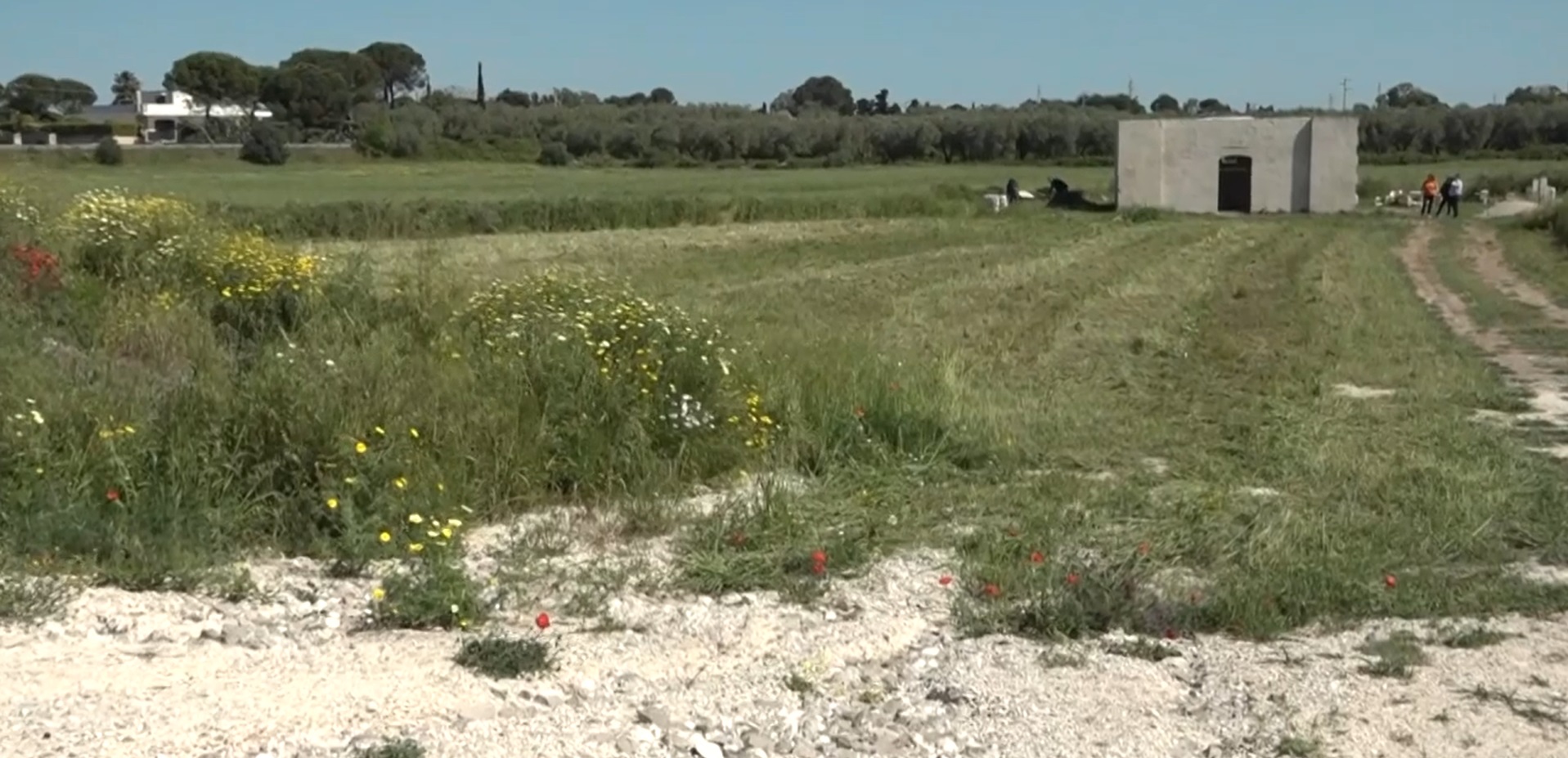
Today, the well is recognized as a historical and cultural asset of the Martanese community. It stands in the Rione Costantino, the heart of the Fiume area, and continues to be valued through events and traditional manifestations, including the historic Fiera de Santu Vitu.
Images
Images of Pozzo Fiume
Arrows to scroll, plus and minus to zoom, Esc to close.