The story translated into Italian Sign Language by an interpreter.
The cave takes its name from the owner of the land on which it opens and is listed in the Regional Speleological Cadastre with the code PU1577. It is one of the most impressive and evocative cavities in the karst system of the Serra di Poggiardo, in the clayey area known as Marirossi, now partly covered by a pine forest and characterized by numerous natural cavities of great speleological interest.
The discovery is credited to the Salento Speleological Group “Pasquale De Lorentiis,” which identified the entrance and documented an initial section. The explorations conducted in the 2000s by the Lecce Speleological Group ’Ndronico significantly expanded the knowledge of the cavity, revealing its extension of “over 150 meters” and environments of considerable scientific value.
In 2014, the same group carried out a planimetric survey that highlighted a structure articulated into several rooms, each with peculiar morphological characteristics.
Among the most representative environments, the following stand out:
• Room of the Crocodile, where karst erosion has shaped a rock formation that surprisingly resembles a crocodile;
• Room of the Rudists, with walls rich in perfectly preserved Cretaceous rudist fossils, testifying to the original geological context.
• Room of the Bats, characterized by formations that evoke the silhouette of small bats hanging from the ceiling.
From a geological point of view, the cave develops in the Upper Cretaceous Altamura Limestones, rich in rudist fragments, sometimes overlain by Miocene lithotypes such as Pietra Leccese and Andrano Calcarenites.
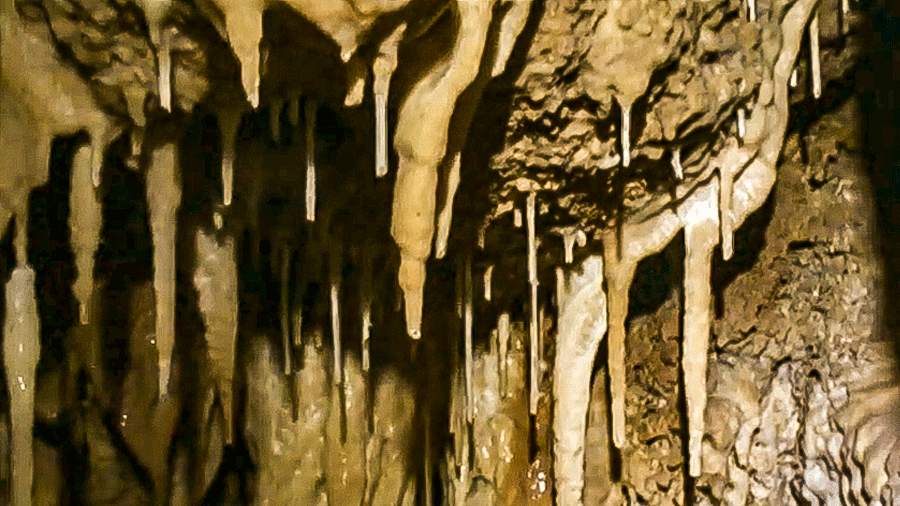
The karst action, through the dissolution of calcium carbonate, has enlarged pre-existing fractures and cavities, generating a complex and branched underground system. The cave features numerous speleothems: stalactites, stalagmites, and calcitic flows, which give the environments a scenic appearance.
The scientific interest is heightened by the presence of a diverse faunal community, with troglobitic organisms (strictly adapted to underground life, such as cave beetles and pseudoscorpions) and troglophilic species, capable of living both in underground environments and on the surface. This biological richness makes the cave a habitat of high ecological sensitivity, deserving of protection and monitoring.
In summary, the Grotta Donato Micello is a cavity of great speleological, geological, and ecological value, and represents one of the most extensive and fascinating underground systems in the Province of Lecce.
Images
Images of Grotta Donato Micello
Arrows to scroll, plus and minus to zoom, Esc to close.