The data comes from on-site surveys. Where there is no survey, no judgment appears: we prefer to say we don't know rather than give you unverified information.
How to read the scale
The level refers to one type of disability at a time. A place can be fully accessible for wheelchair users and completely unsuitable for those who are blind: that's why there is no single rating, and each type has its own evaluation.
Not accessible
Has obstacles that prevent enjoyment.
Accessible with difficulties
Accessible, but with significant difficulties to overcome.
Partially accessible
Some parts are accessible, others are not.
Accessible with a companion
Accessible with the help of a companion.
Fully accessible
Accessible independently, without known barriers.
Mobility impairment
Fully accessible
level 5 out of 5
Verified on 14/09/2026
Visual impairment
Fully accessible
level 5 out of 5
Verified on 14/09/2026
Hearing impairment
Fully accessible
level 5 out of 5
Verified on 14/09/2026
Cognitive disability
Partially accessible
level 3 out of 5
Verified on 14/09/2026
Older adults and reduced mobility
Fully accessible
level 5 out of 5
Verified on 14/09/2026
Services detected on site
Access rampNo
Lift or stairliftNo
Accessible toiletNo
Reserved parking spaceNo
Step-free entranceYes
Tactile guide path (LOGES)No
Tactile map or modelNo
Braille signageNo
Audio guide availableYes
Italian Sign Language (LIS) videoYes
Subtitled contentNo
Hearing loopNo
Easy-read signage / AACNo
Drinking water pointNo
Did you find a situation different from the one described?
The story translated into Italian Sign Language by an interpreter.
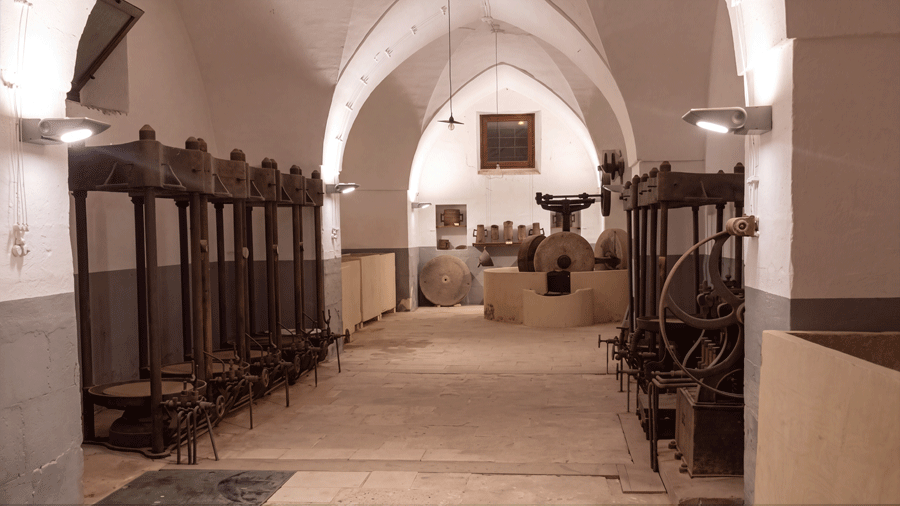
The Ubaldo Villani Museum of Olive Oil Art is located in the ancient Piccinno oil mill in Cannole, built around the 1830s and today one of the few above-ground oil mills still standing in Salento. Divided into two wings, sold separately to Cavalier Ubaldo Villani in the 1930s and 1960s, the building remained closed for almost sixty years before the heirs granted it on loan to the Proloco Cerceto of Cannole, which inaugurated it as a museum on April 28, 2012. The path alternates the oldest tradition, with the harnessing of animals that turned the stone mills, to the mechanical and electric production that replaced them; you can admire the enormous oil tanks, the Genoese presses, and even a rare collection jar with its original wooden lid. The waste from the processing flowed into a well about 40 meters deep, still visible today. A small museum area finally houses fossil bones, Templar relics, and artifacts recovered from ancient churches in the area.
Images
Images of Museo dell'Arte Olearia
Arrows to scroll, plus and minus to zoom, Esc to close.