Necropoli altomedievale e basilica paleocristiana di Vaste
Poggiardo, Vaste
Listen, watch, mark
Sign language
The story translated into Italian Sign Language by an interpreter.
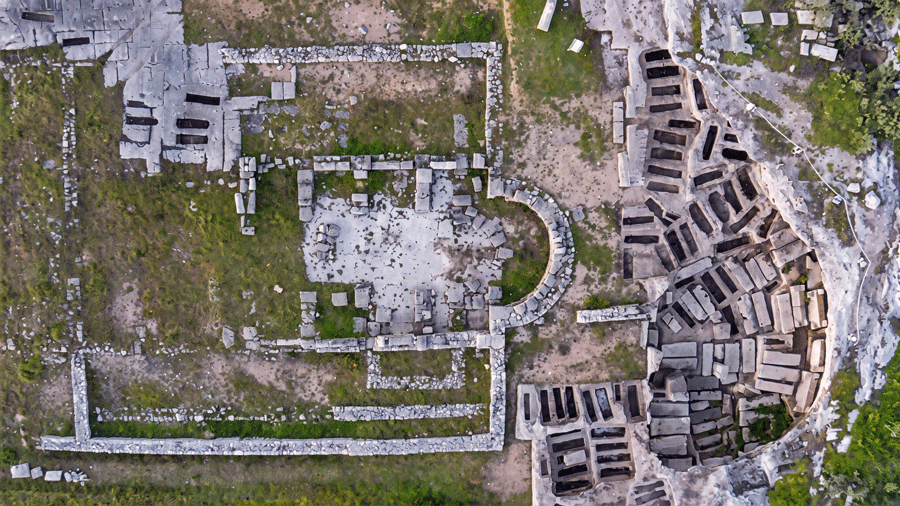
Near Fondo Giuliano, a couple of kilometers north of Vaste, on the Serre, not far from the rock church of Saints Stephen, excavations that have taken place since the 1990s have uncovered an articulated early Christian complex, consisting of three overlapping churches dating from the 4th to the 9th century. The oldest, from the second half of the 4th century, was dedicated to the worship of a martyr saint and surrounded by a vast necropolis with hundreds of burials.
The 2023 excavation campaign clarified some unresolved aspects, focusing on a block structure visible in the north aisle of the 6th-century basilica. Stratigraphic excavation demonstrated that this structure predates the early Christian churches: the blocks rest directly on layers from the 6th–5th century B.C., linked to a Messapic quarry. An archaic rectangular Messapic building was thus identified, lacking a floor and likely used as a pre-Christian cult enclosure, decorated with sculpted frames featuring rosettes and lotus flowers.
The presence of ancient architectural elements reused in the cemetery (columns, stylobates, door frames, cornices) confirms that the area had a sacred function already in the Messapic period, long before Christianization. This indicates a continuity of religious purpose for the site, favored by its dominant strategic position over the plain of Poggiardo and along a route to Otranto.
Investigations in front of the basilica's facade also identified a paved area made of limestone and, further away, two parallel rows of stone blocks that are not related to the stratigraphy and chronology of the ecclesiastical structure but rather may refer to light constructions from the post-medieval period.
Images
Images of Necropoli altomedievale e basilica paleocristiana di Vaste
Arrows to scroll, plus and minus to zoom, Esc to close.