The story translated into Italian Sign Language by an interpreter.
Title of the point of interest: Rural territory and archaeology
The rural territory of Giuggianello constitutes an area of great interest due to its wealth of historical and archaeological finds and various legends that have followed one another over the centuries.
The Dolmen Stabile.
Discovered by Pasquale Maggiulli in 1893 in the Stabile estate, on the border between the territories of Giuggianello and Giurdignano, this dolmen is also known by the name of Quattro macine, due to its location near the homonymous ancient farmhouse.
The covering slab, with an average thickness of 20 centimeters, is marked along the entire perimeter of the outer surface by a wide groove that leads into a circular cavity; and it is supported by 9 orthostats, 2 monolithic and 7 made of overlapping stones, resting on a vast outcrop of rock.
Dimensions height m 1.05, width m 2.60, depth m 1.80.
The Dolmen Ore.
The discoverer is Luigi Corsini, who in May 1979, within a property called Ore, located a few steps from the Quattro macine farmhouse, from which the megalithic monument takes its name due to the presence of a natural sinkhole or Vora (in dialect Ora), identifies a small dolmen characterized by a horizontal covering slab, about 25 centimeters thick, supported by three orthostats, of which only one is monolithic.
The Menhir Croce Caduta.
The Menhir Croce Caduta, 405 cm tall, stands at the edge of a path crossing the road that connects Giuggianello to Giurdignano, in the Quattro macine area, not far from the homonymous farmhouse: its state of preservation is fair, but, as the name itself suggests, it has been toppled since ancient times and lies on the ground against a dry stone wall, often covered by shrubs and spontaneous vegetation.
Precisely because it is on the ground, it is possible to see the cavity on the top that contained a cross presumably made of metal: in Christian times many menhirs were repurposed from pagan worship to Christian worship by placing a cross on the summit or engraving it on one of the sides.
Masseria Quattro Macine.
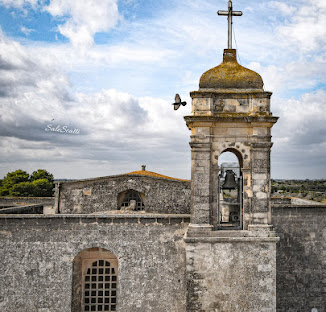
In the area called Quattro macine, in the 7th century there was a Byzantine settlement that was attacked and destroyed by the Turks, later rebuilt, but used as a post station, tobacco factory, and then as a farmhouse. It is located at the center of a megalithic archaeological route characterized by the presence of ancient dolmens and menhirs. Surrounded by the Salento countryside between Giuggianello and Giurdignano, Palmariggi and Minervino, just a few kilometers from Otranto.