The story translated into Italian Sign Language by an interpreter.
The Hill of Children and Nymphs and the Rocks of the Old Woman.
On the heights near Giuggianello, there is a place characterized by silence and numerous legends that have been passed down since ancient times.
1.
The Legend of the Sacred Rocks.
Nicander of Colophon, in the 2nd century BC, recounts: "It is said that in the land of the Messapi, near the so-called 'Sacred Rocks', one day nymphs appeared dancing, and the sons of the Messapi, having left their flocks to go watch, claimed that they could dance better. These words pricked the nymphs, and a contest was held to determine who could dance better. The boys, not realizing they were competing with divine beings, danced as if they were measuring themselves against mortal peers. Their way of dancing was rough, typical of shepherds; that of the nymphs, however, was of supreme beauty. Thus, they triumphed over the boys in the dance and turned to them saying: 'Foolish youths, you wished to compete with the nymphs, and now that you have been defeated, you will pay the price.' And the boys were transformed into trees, in the very place where they stood, near the sanctuary of the nymphs."
2.
The Legend of the Old Woman and the Riddle.
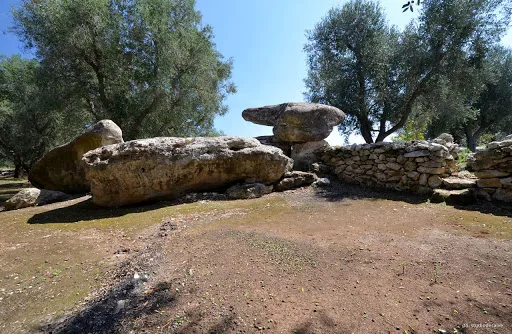
Walking from Quattro macine towards Giuggianello, following the signs, one arrives at the Rocks of the Old Woman, Miocene limestone rock formations, shaped later by wind and rain, emerging from the red earth, creating a suggestive and almost fairy-tale landscape.
According to popular tradition, in this place lived an old witch (the "Old Woman") along with her husband, Orcu Nanni. At dawn on the day of San Giovanni (June 24), the witch would subject travelers to riddles, promising a hen with 7 golden chicks to those who answered correctly and without hesitation; transforming, instead, into stone those who answered incorrectly: Orcu Nanni would then scatter the "new" stones on the surrounding ground.
3.
The Legend of the Old Woman and Fate.
The "Old Woman" slept on a large rock, called "Lu Letticiddhu," right in front of another enormous stone, Lu Furticiddhu, or the spindle, resembling a stone mushroom (and this is exactly how De Giorgi describes it in the 19th century) while deciding the fate of the farmers' harvest.
4.
The Legend of Hercules.
But this enormous rock is also linked to another legend, mentioned by none other than Aristotle in his "De Mirabilis Auscultationibus": "Near Cape Iapigio, there is also a huge stone that they say was lifted and moved by Hercules, even with just one finger." Legend has it that Hercules, fighting and winning against the Giants, returned satisfied on his way back, lifted an enormous rock, and throwing it behind him, it balanced precariously on another underlying rock. And the presence of Hercules would be evidenced by another rock very close to the others, unmistakably shaped like a foot: the footprint of Hercules, indeed.