The story translated into Italian Sign Language by an interpreter.
Title of the point of interest: TRAPPITELLO DEL DUCA
The underground oil mill dates back to the 14th century, and the work inside continued until 1940.
The underground construction was due to various reasons: first of all, because in the past it was easier and cheaper to excavate and expand existing cavities than to build new structures; then because an underground structure maintains a constant temperature (between 16 and 18 degrees), and the production of oil required a temperature that was neither excessively hot nor excessively cold so that the oil would be dense enough and not too liquid.
The oil produced in the underground mills was lamp oil, that is, used for public lighting, particularly in the cities of Northern Europe: the export took place, in particular, from the port of Gallipoli.
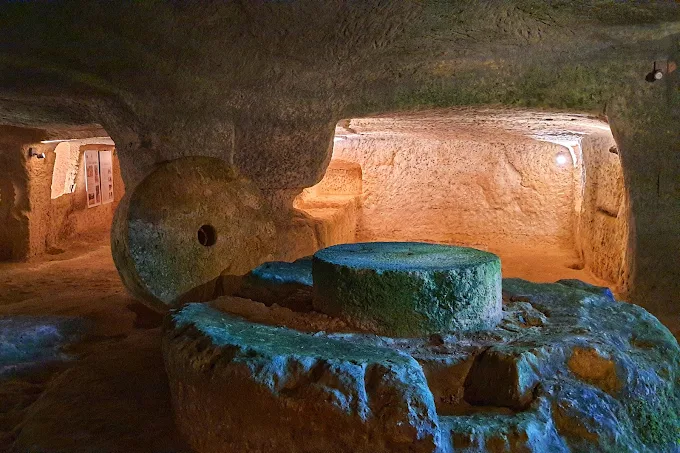
The techniques for producing oil followed a precise procedure: the olives were placed in the “sciave,” that is, in deposits connected to the outside through a visible hole in the vault, from which the olives fell by gravity; subsequently, the olives were placed in the grinding basin, on which the millstones were positioned, stone tools powered by a donkey that walked in circles and, to prevent it from going crazy, was blindfolded.
The millstone served to weaken the pit of the olives until a paste was formed, which was then placed in some rush and/or rope discs (called “fiscoli”) that were stacked on the press, operated by a worker who turned the handle, causing the wooden shaft to descend, and the olive paste contained in the fiscoli was pressed.
The oil produced flowed down the channels and was stored in the cisterns. In the mill, work was carried out continuously all day from October to April. A supervisor, called “Nachiro,” or helmsman, commanded the other workers, called “ciurma.” It is no coincidence that these terms refer to maritime tradition, as during the summer, when oil production was not active, many worked as sailors. During the production period, the workers lived inside the mill, which had dormitories in the corridor, as well as a small kitchen and a stable for the donkeys.
Images
Images of Trappitello del Duca
Arrows to scroll, plus and minus to zoom, Esc to close.